In the early 1980s CBC radio aired Scales of Justice, a series which explored new audio territory by ‘recreating real events in Canadian crime’. The episodes featured readings direct from trial transcripts, often by the actual lawyers involved in the court proceedings. One of those stories was 1947’s Rex V. EVELYN DICK, with John J. Robinette QC reading his own lines from the trial. Edward Greenspan QC narrated, based on Douglas Rodger’s play, How Could You Mrs Dick? The hour-long episode ended at Evelyn’s parole in 1958, and – under time constraints – only told a small part of the story. It was broadcast before 1985, the year Evelyn was granted clemency under the Royal Prerogative of Mercy.
When Brian Vallée wrote The Torso Murder: The Untold Story of Evelyn Dick published in 2001, he requested access to the files held at the Archives of Ontario under RG 4-32, Rex vs. Dick, but was granted access only ‘in part’. Removed from the files were documents containing ‘sensitive personal information of a number of named individuals’. These files are now accessible under the Freedom of Information Act. It’s not so much the names of men she had slept with that is of interest in her statements admitted to the jury, but rather her steadfast and consistent delivery of her account of what happened after she left the hospital with her baby boy.
Additionally, relatives of John Dick did not respond to Vallée’s requests for an interview – he was hung up on by a nephew according to Torso Murder’s acknowledgements page.
John Dick’s brother-in-law, John Wall, solved the mystery of the unidentified torso, and testified during both trials. Dick’s great-great-niece learned about the Torso Murder during a ninth grade history class. Although having a keen interest in criminology, she was unaware of her family’s connection to the case until she came home and asked her father if he’d ever heard of it. She was surprised to learn that the murder victim was her great-great-uncle. The family can think of no reason for John’s killing, other than that he may have heard or seen something that he shouldn’t have, and they suspect that the MacLean family were caught up in a criminal underworld.
Since her release, the details of where Evelyn went and who she became have remained one of Canada’s best kept secrets. Evelyn became an escapee of her past, a protected parolee given a pass to obscurity through the Royal Prerogative of Mercy, a step meaning she would no longer need to report to a parole board, and her previous criminal record would not be flagged at the Canadian border should she decide to leave the country for any given period.
As the 1946/47 trials progressed, revelations surrounding Evelyn’s character made front page news, providing a welcome respite from the horrors of war. To this day, mentioning the name ‘Evelyn Dick’ in Hamilton garners an interesting mix of responses, but they are less expressions of sympathy for the murdered man and more curiosity as to ‘whatever became of Evelyn?’ John Dick’s role as the victim in the case has faded considerably in comparison to the spotlight shined on his wife, who stood out movie-star glamorous with furs and pouting lips.
She was an only daughter whose mother testified against her, and whose alcoholic father progressed into senility throughout the trial. J.J. Robinette saved her life, undoubtedly. But it didn’t stop the general public from hanging her – the rumours around her lifestyle are legendary – but have we only heard one side?
Dr. Phil has a saying, ‘No matter how flat you make a pancake it’s always got two sides’. No matter what you feel about Dr. Phil, I just love that line. If the MacLean’s were alive today they’d make interesting guests on the show, but without them we are left with old photographs and pages and pages of trial transcripts. That’s where I notice some inconsistencies.
Take The Windsor Hotel for instance, the last place John Dick was seen grabbing a bite to eat. The hotel was also known as The Astor, but that’s not been mentioned much. It wouldn’t be important, perhaps, if part of Evelyn’s statements didn’t include reference to her driving past The Astor and seeing John standing outside with a broken bottle in his hand. He told her to “Get the hell outta here!” and he was gone when she drove past again.
Did anyone make that correlation; if it was one, of course? And what about the gang from Windsor – the one that called Evelyn at home to tell her they were looking for her husband, the gang she initially said was responsible for this all? Were they really from Windsor, Ontario, or were they just at the Windsor when they called? Could it be something that stupidly small?
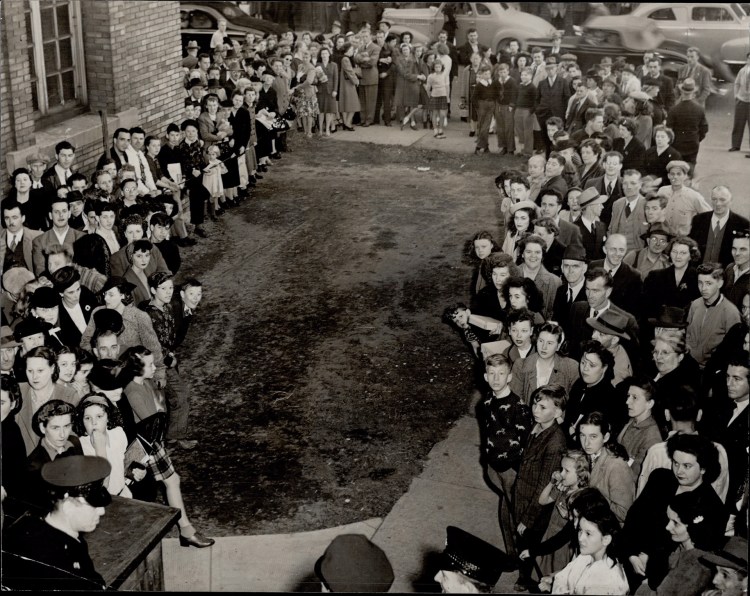
In spite of the brutality of the murder, there is still a certain charm to be found in the imagery accompanying the trials. The photos draw you in; black and white scenes taken from the first trial of October, 1946, when the weather was warm enough that coats were unbuttoned and the crowd of men, women, and children look relaxed as they peer in anticipation at the back door of the courthouse, or blatantly into the camera lens itself. In a photo’s left frame, a boy of around ten or eleven leans forward grinning, while a little girl with a bob of blonde hair stands nearby holding a rope barrier meant to contain the gaggle of onlookers. To the right of the picture, a woman smiles unabashedly at the camera while just behind her, a striking female with rouged cheekbones, painted lips, and a beret looks seriously towards the door. Amid them are the gossipers, the revelers and the cavalcade; bespectacled gentlemen in felt hats and giggling children still in school uniforms, all of them vying for a glimpse of Mrs. Evelyn Dick. The question, “How could she?” hangs in the air.
“How could she?” was my first question, too. Was a woman really capable of cutting up and disposing of her husband in such a gruesome manner? When I approached the archives at the Hamilton Public Library asking for more information, they referred me to Vallée’s book. The Evelyn Dick clipping files are reportedly the most requested item at the library, however the archives do not have copies of the trial papers – just copies of newspaper stories of the time, and photographs/negatives from the trial. For the majority of people interested in the Dick case, Vallée’s book has been the last point of reference, but from the beginning of his book, Vallée took the stance that Evelyn was guilty. In reviewing the Vallée fonds held in his hometown of Sault Ste. Marie (at the Algoma University), it became apparent that he rushed to finish the book (due to a contract stating ‘time is of the essence’), and that he became focused on finding where Evelyn was, rather than discovering why she had gone in the first place.
Evelyn’s intelligence was reported by a psychiatrist as being in ‘a group near dull, normal and moron’, yet a letter handwritten by Evelyn held at the Archives of Ontario shows perfect grammar, punctuation, and beautiful script. Her initial statements to police involving members of a bootlegging criminal ring in Hamilton were laughed at, yet this story begins in a city at the epicentre of organized crime.
So who really was she? Mark McNeil, a journalist from the Hamilton Spectator who continues to enjoy her story, says that “Everyone has an Evelyn Dick story,” and that part of the appeal is the enormous number of people in Hamilton who have something to say about her.
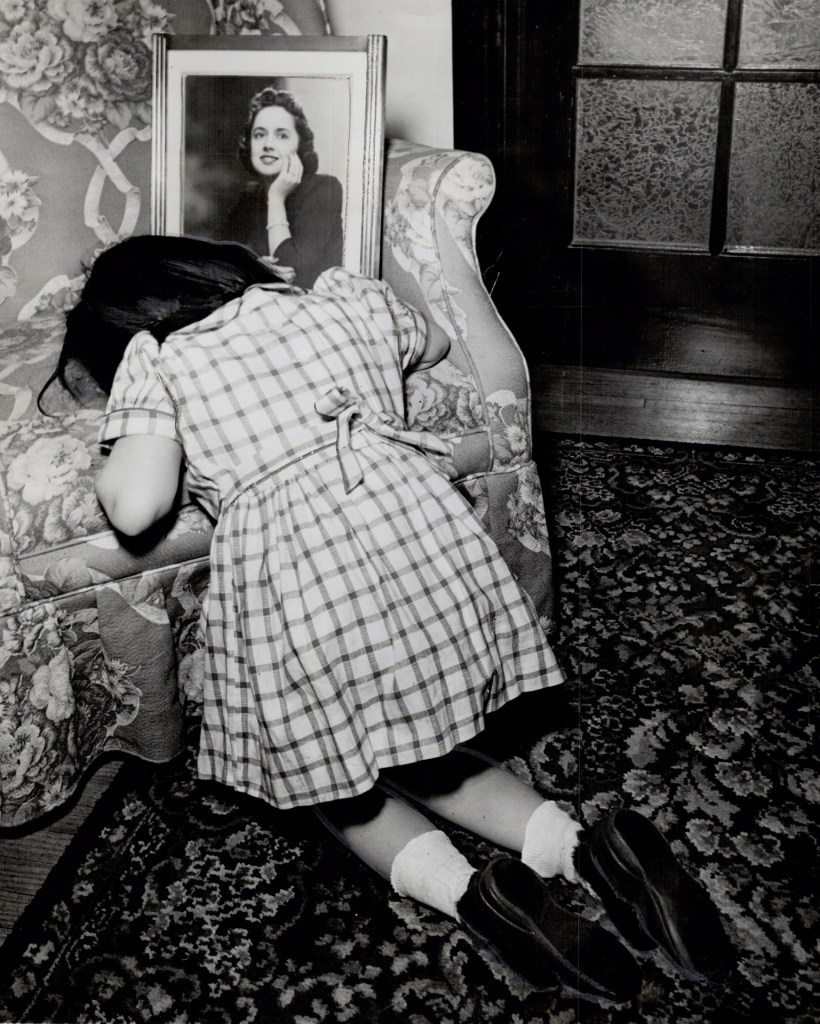
Wherever she is, nothing can surpass how this must have affected her daughter, who was just 4-years-old when her mother was snatched away from her. Writing about Heather – and John Dick – are things I will do separately. They deserve their own space.
I’ve also got a theory about those streetcar tickets …
 The Evelyn Dick Files