In the Supreme Court of Ontario.
THE KING V. EVELYN DICK (Murder)
Tried before The Honourable Mr. Justice Barlow and a Jury at Hamilton, Ontario, October 7, 8, 9, 10, 11, 12, 14, 15 and 16, 1946.
COUNSEL: T. J. RIGNEY K.C. and H. F. McCulloch for the Crown
JOHN J. SULLIVAN and F. S. WEATHERSTON for the Defence
CLARENCE PRESTON, Sworn.
EXAMINED BY MR. McCULLOCH:
Q. Sergeant Preston, you are a sergeant of the Detective Department of the City Police?
A. Correct.
Q. Having been with the City Police over what period of time?
A. Twenty-five years.
Q. You were connected with the investigation this particular case?
A. I was, sir.
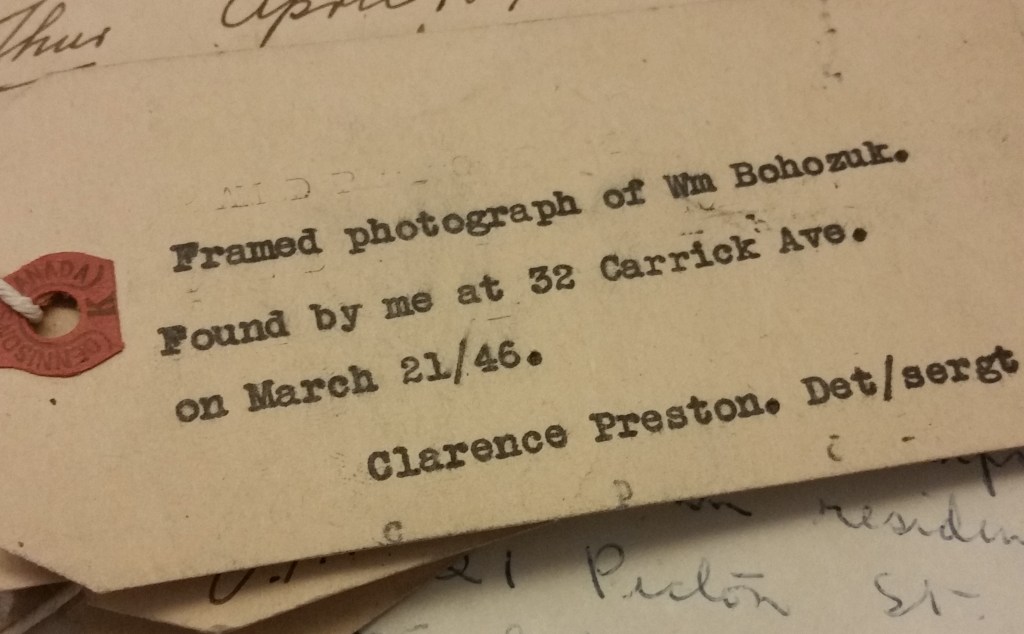
Q. On the 19th of March did you attend the Carrick Avenue property of the accused?
A. I did, sir.
Q. Alone or in company with others?
A. In company with Inspector Wood, Sergeant Farrow and Officer Mattock.
Q. Do you recall what took place so far as you were concerned that day?
A. Yes, sir.
Q. Just outline it, please.
A. I knocked on the door, the door was opened by Evelyn Dick, we entered, and Evelyn Dick went into the front room with Inspector Wood, and I walked along to the dining room where I saw Mr. and Mrs. MacLean and the child Heather. I noticed that Inspector Wood was having a conversation with Mrs. Dick, and in a few minutes Inspector Wood and Mrs. MacLean — pardon me, Mrs. Dick — left for the police station, leaving Sergeant Farrow and Officer Mattock on the premises.
Q. Then did you return to the premises later?
A. I did, sir.
Q. When was that?
A. On the 21st of March.
Q. Two days later?
A. Yes, sir.
Q. Alone or in company with others?
A. With Inspector Wood.
Q. About what time did you arrive?
A. Sometime in the forenoon.
Q. And what took place on that particular occasion?
A. Inspector Wood was having a conversation with Mrs. MacLean. I took a walk upstairs and looked around, went up to the attic; there I discovered that a trunk had been broken open.
Q. A trunk had been broken open?
A. Yes, sir.
Q. What indicated that to you?
A. Well, there was a hammer and screwdriver lying close by, and I could see that the locks had been forced on the trunk.
Q. Anything else you observed about the trunk?
A. Not at that particular time.
Q. Then what next did you observe?
A. Well, I made a cursory search around the attic, down into bedroom, and then I went down into the cellar.
Q. A cursory search, and then you went to the cellar?
A. Yes, sir.
Q. Yes?
A. And in the cellar I saw a bushel basket filled with ashes.
Q. A bushel basket?
A. Yes, sir.
Q. Is that basket here? Would you look at this basket, which is Exhibit No. 51?
A. That is the basket.
Q. It was filled with ashes, you say?
A. Yes, sir.
Q. Where was it in the cellar?
A. Standing by the furnace.
Q. Yes?
A. There was also a metal rocker standing close by, containing ashes, and on the floor was a small pile of ashes.
Q. Yes?
A. I carried the bushel basket out into the garage, which is situated immediately in the rear of 32 Carrick Avenue, tipped them out on the floor of the garage, and with a rake I raked them over, and I found certain articles.
Q. Are those articles here?
A. Yes, sir, they are.
Q. Where are they?
A. I found this—
Q. Exhibit No. 70-32-A, yes?
A. And I found this portion in this particular box.
Q. The centre portion of 70-32-C; yes?
A. And then I went back into the house and had conversation with Inspector Wood, and we both went back into the garage, and there we both went over the ashes and we found further pieces of material.
Q. Are those further pieces here?
A. They are contained in Exhibit—
Q. 70-32-C — the remaining portions of that exhibit?
A. Yes, sir.
Q. Yes?
A. Following that we examined some ashes which were deposited just outside of the garage doors, that is, to the went of the garage.
Q. Would you describe how they were deposited, please?
A. The double doors open on the west end of the garage, and just outside the door—
Q. How far outside?
A. Just outside the door, where there was a rut; a car had apparently been driven up quite close to the garage, and there was a deep rut.
Q. Running parallel to the west side of the garage, or running into the garage?
A. Running into the garage at an angle.
Q. Running in at an angle?
A. Yes.
Q. What would you say the angle was with the west side of the garage?
A. Possibly forty-five degrees.
Q. And how long a rut?
A. Well—
Q. Or did you observe?
A. No, I am not prepared to say that.
Q. Well, these ashes were in this rut, you say, and what area of ashes would there be?
A. Probably cover a square yard.
Q. Did they cover a square yard there?
A. I would say approximately a square yard.
Q. They were over an area of a square yard; is that it?
A. Yes.
Q. Well, give us the measurements; how wide, how long?
MR. SULLIVAN: My lord, may I interrupt at this time to point out that Crown witnesses are remaining in the courtroom.
HIS LORDSHIP: Now, if there are any Crown witnesses in the courtroom that the Crown expects to recall, they must not be here; but any witnesses that you have finished with and are not going to recall may remain in the courtroom quite properly. If there are any who are to be recalled, or any possibility of it, please have them—
MR. RIGNEY: The only safe way, my lord, I would suggest, is that they all be asked to retire.
HIS LORDSHIP: That is what I thought yesterday. Then why aren’t they out this morning?
MR. RIGNEY: That was done yesterday, my lord.
HIS LORDSHIP: It was done yesterday.
MR. RIGNEY: Yes, my lord.
HIS LORDSHIP: Thank you, Mr. Sullivan.
MR. SULLIVAN: Thank you.
MR. MCCULLOCH: May I proceed, my lord?
HIS LORDSHIP: Yes.
MR. MCCULLOCH: Q. I asked you the area of the ashes, and you told us about a square yard. Could you give us the measurements, the area as you looked at it, about how wide and how long?
A. Well, I would say perhaps they extended — the width would be anywhere between two and three feet, and then the area was a little longer than it was wide.
Q. That is, two or three feet wide or long?
A. The width I would say would be between two and three feet.
Q. And the other measurement a little what?
A. The other measurement would be a little longer.
Q. A little more than two or three feet?
A. Yes.
Q. And in this rut?
A. Were deposited ashes.
Q. I say in this rut, these ashes?
A. Covering up the rut, yes.
Q. Had they been rolled over, or could you determine that?
A. No, they did not appear to have been rolled over, but they appeared to have settled a little bit.
Q. Were they flat on the top or not?
A. No, they were not really flat.
Q. How would you describe them?
A. Well, it was an uneven surface, ashes, an uneven surface, but it was obvious they had not been rolled, or a car had gone over them.
Q. So, having observed that, what did you do with those ashes there?
A. Inspector Wood and I examined these ashes, and we discovered quite a number ref objects which we took charge of.
Q. And are they here?
A. I recognize Exhibit (cut off)
Q. Just a minute. You put your on hand on it and I will call it out. 71-33-L.
A. And these are — I recognize those.
Q. 71-33-K.
A. And I recognize those having been found—
Q. Just a minute. 71-33-E.
A. In the morning of the 21st by Inspector Wood and myself.
Q. In the alley?
A. In the alley. We returned later—
Q. How much later?
A. In the afternoon; with Dr. Deadman and his assistant, and Dr. Deadman and a search of the ashes in the garage which I had carried out of the house.
Q. Now, before you carried the ashes out into the garage, were they are ashes in the garage?
A. Not in the garage.
Q. Dr. Deadman made an examination of the ashes you carried out of the house and had placed in the garage?
A. Yes.
Q. Did you observe anything take place there?
A. He found certain objects, and they were placed in a separate box.
Q. Are they here? Exhibits 72-35-C, 72-35-A, 72-35-B. Yes?
A. Then Dr. Deadman made a search of the ashes found in the alley outside of the garage.
Q. There, at that time?
A. At that time; and found some pieces which were picked up and put in a common box with those that were found by Inspector Wood and myself in the morning from the ashes outside the garage.
Q. Have you them here?
A. These appear to be—
Q. Just one moment.
A. Those appear to me to be the objects — (remainder of answer inaudible).
HIS LORDSHIP: The reporter cannot hear what is being said.
MR. MCCULLOCH: You touch the ones that are those: 71-33-B, 71-33-A, 71-33-G, 71-33-I.
HIS LORDSHIP: Mr. McCulloch, you would have to deal with this in some other way. The reporter cannot hear what the witness says down there at all, because he is turning to the jury, and we cannot hear at all.
MR. MCCULLOCH: Q. Witness, if you will just keep your voice raised a little louder, so that the reporter can hear. Then what, witness?
A. Those pieces were placed in a common box, and then the ashes from the alley were gathered up and placed in a box, the ashes in the garage were placed in another box, and they were taken to Central Police Station and then kept under lock and key.
Q. Yes?
A. On the day when Inspector Wood and I were making a search of the ashes outside the garage I saw Inspector Wood pick up part of a tooth, which is marked in my writing, in a vial, number one.
Q. Come and pick it out.
A. The tooth in the vial with the double prong was picked up by Inspector Wood in the morning from the ashes outside the garage.
Q. That is Exhibit No. 68.
A. The stump which is in with this former exhibit—
Q. Just a minute. The stump is in with what former exhibit?
A. One just mentioned.
Q. The same vial?
A. The same vial.
Q. 68.
A. Was found by Inspector Wood in the afternoon when Dr. Deadman was present; found in the ashes outside the garage.
Q. That is, outside the garage they were found or some other place?
A. Outside the garage.
Q. In the search that took place outside the garage?
A. On the 21st.
Q. Thank you. Yes?
A. On the following Sunday—
Q. The following Sunday; that would be the 24th.
A. Correct.
Q. Of March. Yes, witness?
A. The ashes were taken from Central Police Station down to the Morgue where they were examined by Dr. Deadman, his assistant, Inspector Wood and myself.
Q. Yes?
A. And other objects were found, which were placed in the common box.
Q. Would you come and pick them out, and keep your voice raised?
A. I recognize those as having been found at the hospital on Sunday the 24th.
Q. 71-33-H.
A. And there were similar pieces to these objects in those three boxes.
Q. 71-33-B, 71-33-A, 71-33-G.
A. Also found in the ashes at the hospital — the ashes which were found outside the garage —those articles there, which were placed in this vial by me and marked number two.
Q. Exhibit No. 69, which have been referred to by the expert as teeth. Found as a result of the examination at the hospital of ashes that were taken from where?
A. 32 Carrick Avenue.
Q. Where?
A. From the ashes found outside the garage.
Q. Yes.
A. Those objects that we found were placed in boxes and taken to Toronto by Inspector Wood and myself, and handed over to Professor Grant.
Q. Now, there are some boxes here that have not been referred to. Would you look at them, please?
You will notice they are all marked with various marks. Have you any comment to make on any of them?
A. I say that they are similar to the — I recognize that particular part in that box.
Q. Recognize a part in the box of 71-33-D, which is the part nearest a label on the front, numbered 33-F?
A. Yes, sir.
Q. You recognize that as what?
A. I recognize that as a piece that was taken from the ashes found outside the garage at 32 Carrick.
Q. Now, that particular exhibit that we have just referred to, 71-33-D, what does the label on the front, 33-F, indicate, or do you know?
A. No, sir, I don’t.
Q. Do you know what the number 33 indicates?
A. Yes; 33 means to say that those bones were taken from the ashes found outside the garage.
Q. All the exhibits that have the numeral 33?
A. Yes, sir.
Q. That would include — just come down for a moment — that would include these four boxes?
A. Yes, sir.
Q. Which are 71-33-J, 71-33-C, 71-33-F, 71-33? (off page) And then I have another exhibit here that has not been referred to, just one, Exhibit 70-32-B.
A. 32, that would be a part which was picked up by me in the garage from the ashes which were taken out of the house.
Q. So that, just to recapitulate, the number 32 was designated to what ashes?
A. Those taken out of the house by me.
Q. And you have already told us about 33. And what about the numeral 35?
A. They were taken by Dr. Deadman in the ashes which were taken out of the house by me.
Q. And will you repeat again what 33 was?
A. 33 were the parts that were taken out of the ashes in the alley, both at 32 Carrick and at the Morgue.
Q. When you say Morgue, does that include the hospital?
A. Well, at the hospital, yes, the City Hospital.
Q. The Morgue is at our hospital?
A. Yes, sir.
Q. Now, will you just direct your thoughts to the times other than the time of the ashes. Do you remember when the funeral took place? Do you recall the funeral taking place?
A. I recall the funeral but I cannot recall the date.
Q. When the funeral took place did you approach the accused?
A. I did.
Q. Under what circumstances?
A. She was at the Police Station at the time, and I asked her if she wished to attend the funeral of her husband. She said, “No.” “Well,” I said, “the press asked me to find out; what reason shall I give?” She said, “Tell them I am very sick; I have used three pads already today.”MR. MCCULLOCH: All right, Mr. Sullivan — there was one other question, if I may, if you will permit me.
HIS LORDSHIP: Yes, Mr. McCulloch.
MR. MCCULLOCH: Q. Witness, did you make any examination of the garage?
A. I did, sir.
Q. Do you recall when you made it?
A. On the 21st of March.
Q. And were you alone or in company with others on that occasion.
A. With Inspector Wood.
Q. Just keep your voice raised. Just what was the result of your examination?
A. There was some stains on the screen door and on the side of the garage, on the south side of the garage.
Q. The screen door you speak of, where was it?
A. Leaning up against the south wall of the garage inside.
Q. When on went in the garage what did they observe, or he?
A. Well, the place was pretty well cluttered up with lumber, crates, screen door just inside the garage to the right; that was the first object.
Q. To the right; what side would that be?
A. On the south side.
Q. On the south side; and what condition was it in? Lying down, standing up or what?
A. Standing up against the — leaning up longways.
Q. Against the—
A. South wall.
Q. The south wall.
A. Yes, sir.
Q. You describe that as standing up, upwards; is that what you mean?
A. No, it was lying down on its side.
Q. Lying down on its side, lengthwise?
A. Yes.
Q. That was the screen door; what did you observe about the screen door?
A. There were some stains on the screen door.
Q. Would you just describe where they were?
A. They were on the frame; I am not prepared to say just what part of the frame.
Q. Well, I mean the upper part or the lower part or could you say?
A. If I remember rightly, they were on one end of the door; I am not sure whether it would be the top or the bottom; I am not sure of that.
Q. Can you say which direction?
A. No, sir, I cannot.
Q. What did you observe about the stain. Anything?
A. I noticed it was red in colour.
Q. Did you do anything about that stain?
A. Well, I noticed Inspector Wood take his pen knife out and remove parts of the door.
Q. And did you observe any other stains than the stains that you have spoken of on the door?
A. No, sir.
Q. Do you recall any other pieces of wood being taken than the piece from the door?
A. There was a piece of wood removed from the side of the garage.
Q. Where was it with relation to the piece taken from the door?
A. I am not prepared to say.
Q. You are not prepared to say that. Did you actually observe that particular piece that was on the side, other than on the door?
A. I did.
Q. And what have you to say about it?
A. There were similar stains on it.
Q. How would you describe the stains as being similar?
A. Well, they were similar in colour, and looked like a splash or a rub.
Q. Have you seen bloodstains?
A. I have.
Q. How did they compare with what bloodstains you have seen?
A. I would say they were the same.
Q. I show you Exhibit No. 8, a photograph which has a screen door; do you recognize that photograph?
A. Yes, I do.
Q. Anything particular in it that you recognize?
A. Yes, I notice that — I notice this is the MacLeans’ screen door, because the wire netting is torn, and there are some slivers, one, two slivers, taken out of one end.
Q. Is that the screen door you refer to?
A. Yes, sir.
Q. Do you recognize the piece of wood that you say was taken out of it? Do you recognize the place in the door?
A. Yes, sir.
Q. Would you show his lordship, and put a circle around it wth your pen and ink? Show his lordship please, before you put the circle on.
With your lordship’s permission, may he put the circle on?
HIS LORDSHIP: Yes, put the circle on.
MR. MCCULLOCH: May I show the jury, my lord?
HIS LORDSHIP: Yes.
MR. MCCULLOCH: Q. The parts that you have circled, what do they show?
A. Those are the places where Inspector Wood took chips out of the door.
Q. And you saw the chips before he took them out?
A. I did.
Q. And what did you observe about them?
A. They were stained with a red stain which looked like blood.
Q. I am showing you another photograph, Exhibit No. 9; is there anything you recognize in that photograph?
A. Yes, sir.
Q. What do you recognize in it?
A. I recognize where two chips were taken out of a rather heavy timber on the side.
Q. The side of what?
A. The side of the garage.
Q. That is what you have been telling us about?
A. Yes, sir.
Q. Would you show his lordship?
HIS LORDSHIP: You had better circle those, too witness, with your pen.
MR. MCCULLOCH: With your lordship’s permission may I show the jury?
The witness has circled in ink what he says are two chips taken out of wood on the side of the garage.
Q. Once again, witness, what condition was it before those chips were taken out?
A. Where those chips were taken out were red stains which looked like blood.
Q. I have an envelope here; it is marked Exhibit No. 55. Would you look at the contents, please? I also have another exhibit, 56; would you look at 56 also? Just keep them, please. Do you recognize those exhibits, witness, or not?
A. No, sir I am not sure about those.
Q. Very well, thank you.
HIS LORDSHIP: Any questions, Mr. Sullivan?
MR. SULLIVAN: Yes, my lord.
CROSS-EXAMINED BY MR. SULLIVAN:
Q. Getting back to your evidence with regard to the day of the funeral, you have told us in examination in chief of a conversation with Mrs. Dick; did you tell her anything on that occasion?
A. I told her her husband was being buried that day.
Q. Is that all?
A. That is about all I can remember.
Q. Did you advise her regarding her conduct on that day?
A. I don’t believe I did.
Q. Did you tell her not to go to the funeral?
A. I did not.
Q. Did you tell her that if she stayed at King William Street you would see that she would have dinner there?
A. I did not.
Q. Did she have dinner there that day?
A. She may have done.
Q. Were you there when she had it?
A. If you tell me the date you are speaking of, I may be able to answer the question.
Q. Well, I thought that you knew the date, because I don’t; I don’t know the date of the funeral. I am informed by Mr. McCulloch it was Friday the 22nd.
A. I don’t think she had her dinner that day.
Q. But you did have quite a conversation with her that day, didn’t you?
A. Yes; there was a statement taken that day.
Q. Did you either before or after that statement make any reference to providing her with a dinner if she stayed there?
A. I am not prepared to say, but if she stayed over noon she would be supplied with a dinner.
Q. But you did not at any time advise her not to go to the funeral?
A. I did not.
Q. Exhibit No. 9, that is the lumber in the garage, and you have circled the marks where pieces were taken?
A. Yes, sir.
Q. What type of lumber was that?
A. Probably pine; I am not an expert.
Q. Well, was it new or used?
A. Oh, used lumber.
Q. You have worked rather closely with Dr. Deadman in this case, haven’t you?
A. Yes.
Q. And you know what the result of his tests of Exhibits 55 and 56 were?
A. What are Exhibits 55 and 56?
Q. 55 and 56 are the pieces of wood which my friend Mr. McCulloch produced for your inspection.
A. No, sir, I do not.
Q. You do not know the results of those tests?
A. No, sir.
Q. At the time that you were down at Carrick Avenue taking the ashes out of the cellar, what was the condition of the back yard there?
A. Fairly clean.
Q. Was there a lawn?
A. There was some grass, not what you would really call a lawn; it was rather rough, I would say.
Q. And was there another building besides the garage you mention, in the back yard?
A. I don’t think so, sir.
Q. Did you see any trace of one being dismantled?
A. No, sir.
Q. Were there ashes in the back yard?
A. No, sir; if there was I did not see them.
Q. Did you examine any portion of the back yard for ashes?
A. Yes.
Q. Where?
A. In the back; the only ashes that I saw were those in the alley I spoke of.
Q. But you did not examine the back yard itself for ashes?
A. I believe I did.
Q. And did you see any?
A. No, sir.
Q. At that time was the picket fence separating the alley from the yard?
A. No, sir.
Q. It was open?
A. It was open, yes, sir.
Q. And did you examine any other portions of the alley besides that spot just outside the garage?
A. Yes.
Q. Were there other ruts?
A. There were other ruts, yes.
Q. Were there other ashes?
A. No, sir, not that I saw.
Q. How far did you examine the alley in either direction at 32 Carrick?
A. Oh, not any great distance either side.
Q. Just the ashes in the rut immediately in front of the garage?
A. Yes.
Q. There are several other garages in that alley aren’t there?
A. Yes, sir.
Q. Did you look in the front of any of those?
A. Yes, I did.
Q. Were there signs of ashes in front of them?
A. No, sir.
Q. With regard to the fragments of bone which you have proved here today, I understand you to say that you took them to Professor Grant?
A. Yes, sir.
Q. Along with Inspector Wood?
A. Correct.
Q. And at the time you gave them to Inspector Grant, did you give him any instructions?
A. I did not, sir.
Q. Did he mention any portions of anatomy?
A. There was a slight discussion as to one or two of the parts, and I heard Inspector — Professor Grant mention to Inspector Wood that they were definitely human bones.
Q. And what was said about that?
A. Nothing that I can recall, other than that.
Q. That is all the conversation there was at that time?
A. As far as I heard.
Q. That was at the end of March when the bone fragments were first taken to the professor?
A. Correct.
Q. And they were subsequently taken away from him, weren’t they?
A. I don’t know, sir.
Q. You were not present on any other occasion?
A. No, sir.
Q. You did not go down to visit Professor Grant this fall?
A. No, sir.
Q. August or September?
A. No, sir.
Q. In your identification of these bone fragments, you say that they are the same ones that you took from the pile of ashes in front of the garage at 32 Carrick?
A. Yes, sir.
Q. And the bone fragments which you took from the ashes that you took out of the cellar?
A. Yes, sir.
Q. And you kept them separate all during your examinations?
A. Yes, sir.
Q. When you emptied the bushel basket of ashes on the garage floor, how close did you empty them to the ashes in the alley?
A. Probably six feet.
Q. Did you make sure that they did not intermingle?
A. I did, sir.
Q. Did you examine them yourself on the first occasion?
A. Yes.
Q. And when you examined them yourself did you leave them with the ashes or take them away from there — the bone fragments?
A. Took them away, sir, took them away.
Q. Took them away.
A. Yes, sir.
Q. And it was subsequently that Dr. Deadman came down?
A. Yes, sir.
Q. And he examined the ashes with you?
A. Yes, sir.
Q. And at that time were the ashes still kept separate?
A. Yes, sir.
Q. What was the condition of the ground in the alley at the rear of 32 Carrick when you found the ashes there?
A. Dry.
Q. Dry?
A. Clear.
Q. There had been wet weather just before that, hadn’t there?
A. Oh, yes.
Q. But the ground was completely dry?
A. Well, dry enough to kneel on.
Q. Dry enough to kneel on. That is all, thank you.
HIS LORDSHIP: Any questions?
MR. MCCULLOCH: No, my lord.
 The Evelyn Dick Files