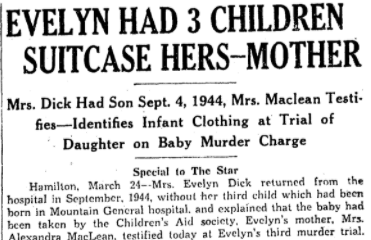
On March 24, 1947, the Toronto Daily Star ran a teaser with this entry into a story taking up a right hand column on the front page of the paper.
She didn’t have an accompanying photo, rather, that was taken up by something that seems timely; kids were going on strike, protesting the removal of their principal.
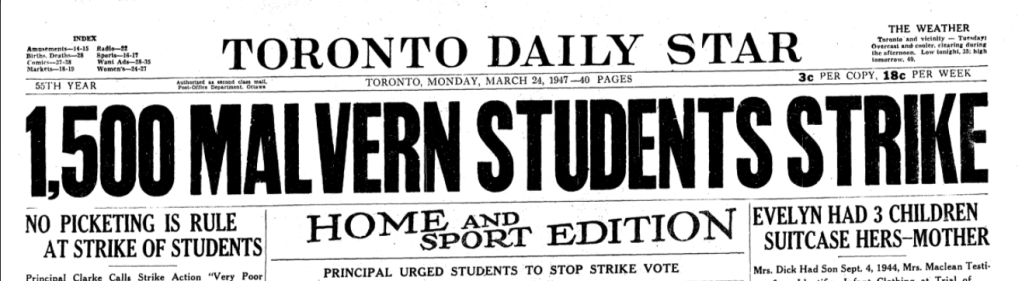
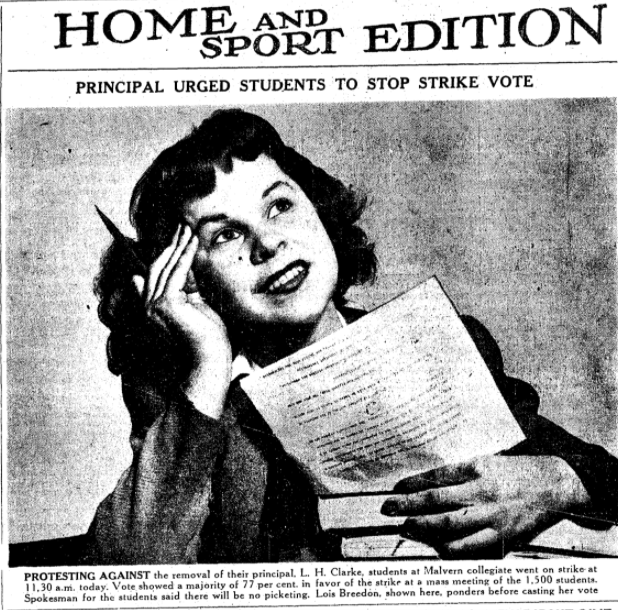
Pretty impressive that out of 1500 students, 77% of the kids would turn up.
Lois Breedon poses here – apparently pondering which way to vote. It reminds me of the photo from the same paper, while Evelyn was awaiting sentencing in the first trial. Her mother smiling, holding a framed photo of Evelyn looking glamorous, hand cupping her head in a similar manner.
At the bottom of the front page, with the headline, ‘WOMAN FREED ON SPY COUNT TO TAKE JOB AT CAMBRIDGE’ is another story deserving of a mention. After being accused of spying in the recent espionage trials in Ottawa involving the defection of Ivor Gouzenko, 40-year-old, Agatha Chapham, was happy to be taking a position in Cambridge, England, and getting away from Canada. “After all the unfavourable publicity I received some months ago I am only too happy to confirm at this time my appointment to Cambridge,” she said.
Over on page 2 Evelyn’s story continued: ‘Detective John Freeborn was called into the courtroom, and from a large beige suitcase, he began removing the contents, including a cardboard box . . . from the box he took articles of baby clothing, some of it appearing to be mud-stained. There was also a burlap bag and a small half-bushel basket. Evelyn watched this procedure with her characteristic side-glance.’
The Toronto Daily Star of March 24, 1947 recounted the testimony of each witness and also provided the names of the jury members: S. J. Birrell, accountant; James P. Bell, general manager; Ivan Andrews, tire builder; Joseph C. Berry, trimmer; David L. Bennett, first aid man; Glen Bowman, clerk; George T. Britton, secretary; Sydney Butterfill, designer; Thomas Stock, salesman; Lawrence Atkinson, superintendent; Clarence Beatty, erector; John H. Bullock, garage superintendent.
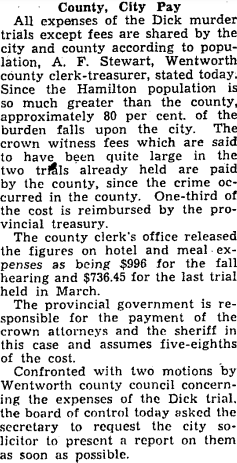
The same story also explained the burden of cost associated with the trial proceedings:
In a column to the right of Evelyn’s continued story on page 2, there is reporting on discovery of a body, apparently brutalized after being transported through an industrial wood chipper at the Ontario Pulp and Paper Company in Thorold. Being 1947, they allowed for great detail in the journey of the body, describing how: ‘The man’s body was severely injured and identification may be only possible through a wound on his right arm. Chief of Police Dennis Harold of Thorold South township said that the man met a “terrible’ death.” His body may have been among a pile of lumber which is conveyed into the plant by machine, police said. By this machine, police said it was taken through a drum in which there are knives used to peel the bark off the logs. After coming from this drum it was carried to another part of the plant. There a worker whose duty it is to watch for knots in the wood saw the body. He spread the alarm and the conveyor was stopped.’ The death was considered suspicious.
The March 25, 1947 edition of The Globe and Mail explains how difficult it was to get into the courtroom as a spectator, describing how an elderly woman was turned away:

‘BY HELEN BEATTIE: Hamilton, March 24 (Staff). — The brisk, determined old lady pushed through the crowd and tried to brush past the policeman at the top of the Wentworth County courthouse stairs. She whisked something from her purse and showed it to him.
“This will get me in anywhere,” she announced.
He took a look at it. It was a regimental badge. It didn’t get her in.
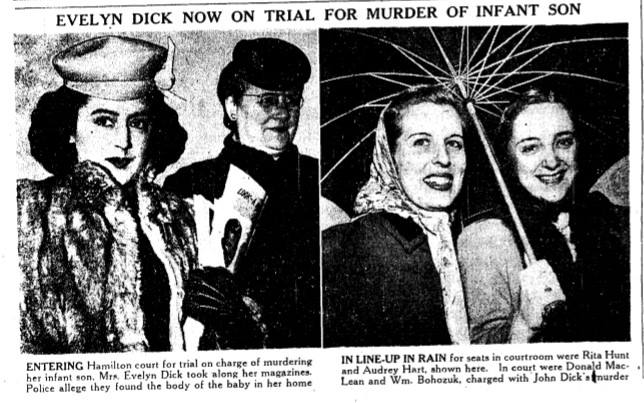
Typical of the crowd which lined up yesterday to see Evelyn Dick go on trial for the murder of her baby, the old lady’s attitude was that of a person done out of listening to her favourite soap opera. That is how they seemed to take it.
They were lined up at 1 o’clock yesterday for the afternoon session which began at 2:30. It was pouring rain, but they didn’t care. They had read the synopsis of preceeding installments in the newspapers. This would be another thrilling chapter . . . From the curious spectators’ standpoint all it seemed to lack was a good commercial.
Before 10 o’clock William Bohozuk and Evelyn’s father were in their places. They celebrated their last two hours of freedom on bail in the courtroom. At 12 noon, handcuffed, they were taken back into custody. But they had a good time when they were out on bail. Bohozuk was at a supper-dance Saturday night and a request-number was played for him. Maclean had visited with a lot of his old cronies from the street railway.
A matron sat between Bohozuk and Evelyn. Though jointly charged in the murder of the infant, they will be tried separately. They exchanged no glances in the courtroom.
Evelyn, a little thinner than before, wore the same grey kid coat and grey beret she wore at her last trial. Sitting three feet behind her, a girl in a green coat with exactly the same kind of a hat smirked self-consciously.’
The same article describes the demeanour of Alexandra Maclean on the witness stand: ‘First witness was the girl’s mother, Mrs. Alexandra Maclean, who was garbed in Harris tweed and mink fur. She looks like the president of a women’s committee bent on “deploring” something. She showed no emotion as Crown Attorney T. J. Rigney gently coaxed out her evidence.’
 The Evelyn Dick Files