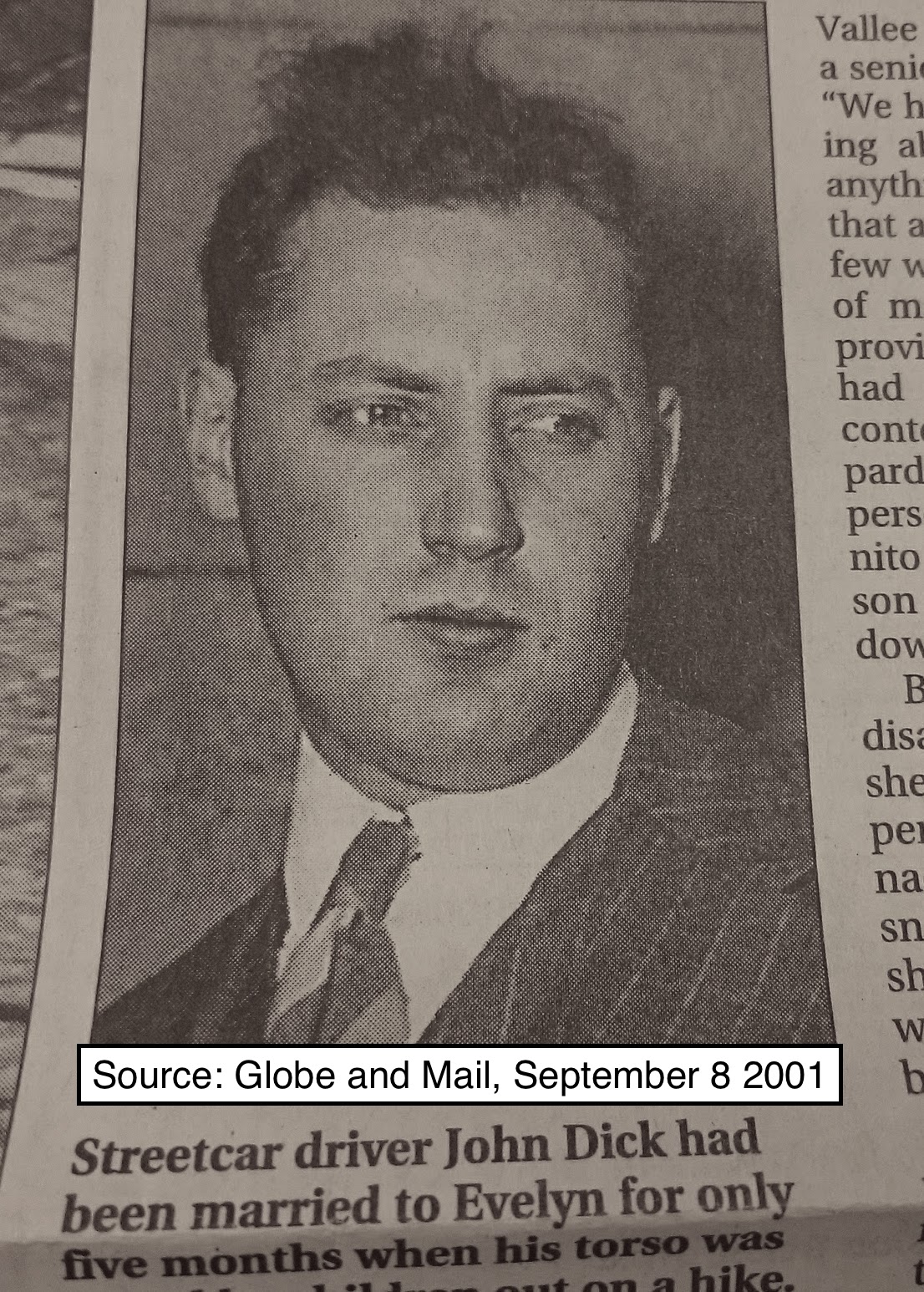
The evening edition of the Globe and Mail on March 19, 1946, reported that pathologist, W. J. Deadman, had deduced that the man found deceased on the Hamilton mountain had likely died from a head injury – either from a gunshot (given that a superficial bullet wound to the chest area was also evident), or through a severe beating. Since the missing head had not been found, it was impossible to say with certainty.
The paper also provided an update on a bloody, bullet-holed shirt that had been discovered by city employees on March 7 – long before the body was found. During the first trial city worker, George Meharg, described how he had been traveling up the Mountain Boulevard in a truck with co-worker, William Rushton, around 8:00 a.m. on the Thursday morning when they saw ‘halfway between Sherman and Ottawa’ a blood-covered, blue pin-striped shirt on the road. Meharg asked the driver to stop and went to look at it. “It was all bloodstains,” Meharg said during questioning. “So I picked it up and I put it on the side of the road.” He explained that there was a lot of blood around the neck of the shirt and the arms had been cut – or torn – off. The icy-blood looked – as he described – as if ‘the sun was playing with it a while‘ causing the freezing to melt. The shirt was fully-buttoned up, indicating that it had been pulled off whomever had been wearing it. It lay in a heap and appeared to have been simply discarded on the road, and not run over by another vehicle before they had found it.
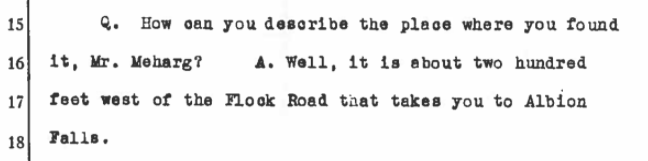
Not knowing quite what to do with the shirt, he had left it in a ditch next to a sign for ‘Flock Road’. He contacted the police on March 17 – ten days later – after hearing that a body had been found. When he went back to the spot with police it was – he believed – exactly as he had left it.
The shirt was an important step forward in identifying the mysterious torso, and further, setting into place a more accurate idea of when the death occurred. You would think somebody who had taken so much effort in removing head and limbs would have spent more time hiding such an important piece of evidence as a piece of clothing owned by the victim.
A statement made by Coroner Dr Isaac E. Crack at the time of discovery, and published in the March 18 Globe and Mail, suggested more care had been taken with the torso’s disposal, suggesting that – “in his opinion, ‘the body was not thrown from an auto, and that it must have been carried the 30 to 40 feet from the scenic road which follows the escarpment from Hamilton East the seven miles to Mount Albion Falls, to the edge of the embankment. The position of the torso under the ledge indicated also that it had been placed there ‘in an effort at concealment.'”
The shirt was to be turned over to the OPP Criminal Investigation branch in Toronto.
During first trial questioning, Leonard Mattick of the provincial police described a ‘trace’ path of a broken tree limb, and skid marks in the in the dirt and dried leaves beginning about four feet away from the body. The head was pointing away from the road, further down the mountain.
When he first arrived at the scene there had been one male adult waiting with the children, a “Mr. Laid … ” He couldn’t recall his first name.
On March 19, Inspector Charles Wood of the Criminal Investigation Branch, Toronto, released a description of the dead man. The Globe and Mail reported that the torso was believed to belong to a man of approximately ‘5 feet and ten inches tall; 170 to 185 pounds in weight; fair hair; wearing full-length, buttonless combination underwear of mixed wool and cotton with Harvey Woods PDQ brand on it and elastic at neck and back, size 44. The shirt, which has not been definitely established as belonging to the victim, is a new blue striped shirt of print material, “Fordan” brand, size 15 and a half.’
The Kammerer’s – John’s Cousins
Alexander and Anne Kammerer were John’s cousins and lived at 215 Gertrude Street in Hamilton. John had been living with them for the five weeks prior to March 6 (the last day he was seen) and he hadn’t called or shown his face at the house since he got off the streetcar around 10 am at Sanford Avenue and King Street that day. He was supposed to report for work, but never showed up that day and hadn’t contacted his cousins on Gertrude Street since then. There had been one weekend in February during the time he was staying with his cousins when he hadn’t come home, but he had called to explain where he was in that instance.
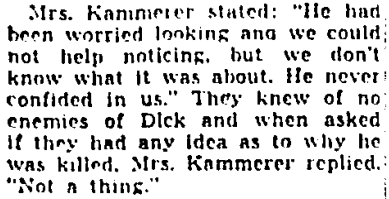
In an interview for the Globe and Mail the day the identity of the torso was announced, Anne stated that John had, ‘looked worried lately’. “We could not help but noticing, but we don’t know what it was about. He never confided in us.” The story went on to say that the cousins ‘ … knew of no enemies of Dick and when asked if they had any idea as to why he was killed, Mrs. Kammerer replied: “Not a thing.”
According to Mrs. Kammerer she’d spoken to Evelyn on the phone a couple of times, but only met her once in person. While under oath at the first trial Anne had said she had met Evelyn in January, 1946, at the boarding house at 148 Emerald North – where John had been living before he met Evelyn. If this is correct (and luckily we can come back and edit) this would be after John had left Carrick Avenue and before he had moved in with his cousins at 215 Gertrude.
Anne tried calling Evelyn on Saturday, March 9, to see if she’d seen or heard from John. Evelyn hadn’t spoken to him at that point, and when Anne called during the next week there was still no news.
Interestingly, Anne also said that about two weeks before John had gone missing, he’d asked his cousin to call Evelyn to check in on her.
“He had asked me to call he, and he had not been able to get in touch with her, so he asked me to call her up and see if I could get in touch with her, and when she answered the phone she sounded kind of strange, and she excused herself over the phone by saying that she had been ill and she had had a tooth extracted, and that was why she sounded strange over the phone.”
First Trial Transcript The King versus Evelyn Dick – Mrs. Anne Kammerer (Archives of Ontario RG 4-32)
The Hamilton Street Railway (HSR) were also on the look-out for John Dick. After getting off the streetcar, John had gone to the Inspector’s office at the HSR’s car barn on King Street East. He’d asked William Mottram, an Inspector, if he could leave his equipment – his uniform cap, money bag, change machine and tickets – in the office, since it was still early and his shift didn’t begin till 4:00 pm. John Dick left the office wearing a brown felt hat, leaving his equipment in the office.
When Mottram left the office at 12:15 pm, the equipment was still in the office; however, when he returned around 2:00 pm, the equipment was gone and John’s brown fedora was on the desk. Harry Walter was the Inspector who had relived Mottram at noon. He said that John had stopped in the office briefly to pick up his HSR equipment and to say hello. Harry didn’t notice specifically John leaving the hat on the desk, but noticed it was sitting on the desk after he’d left. John had told him, “I’ll be back,” but never did.
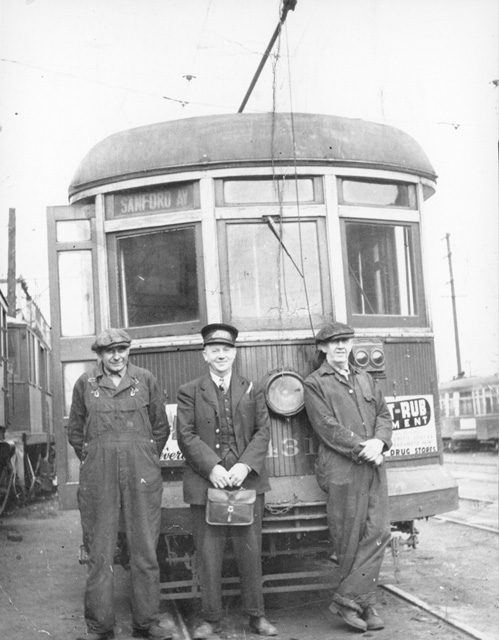
Raymond Castle, Superintendent with Hamilton Street Railway
Raymond Castle was John’s boss at the Hamilton Street Railway. As Superintendent, he was also Donald Maclean’s boss. Mr. Castle stated during the first trial that ‘according to the company records,’ John had not shown up for his regular shift of 4pm to midnight on Monday, March 4. On the Tuesday he turned up saying he’d been sick the day before, and that he still didn’t feel well but was willing to work. He didn’t show up at all on Wednesday, and when he didn’t appear on Thursday, March 7, Mr. Castle was informed by another employee that John had not reported for work for a second day in a row, and he had $75 of company money with him.
On Friday the 8th of March, Mr. Castle asked Donald Maclean if John was still living with his wife on Carrick Avenue but was unable to get an answer. During the next week, Mr. Castle had some business to attend to out of town. On March 14th, he wrote the below letter to Mr. Harry Branch of Vineland, believing that he may own property next to land owned by John’s family.
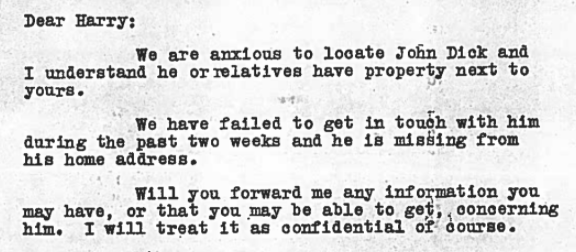
It wasn’t until Friday, March 15th that Castle called the provincial police and reported that John Dick was missing. Castle told police that John had been living at 32 Carrick Avenue and that he had family in Beamsville. During the course of his 3 year employment with the HSR, Dick had not been absent with company money, and Castle was reluctant to take out a warrant for his arrest as the police suggested. However, upon their insistence, he relented and called the Hamilton Police.
“The Provincial Police also asked me to notify the local police, and I said I had not done so because I thought, since I wanted inquiries made at Beamsville, it was outside their jurisdiction, but at their insistence I did notify the local police.”
Raymond Castle RG 4-32 – Attorney General Central Registry Files, File 1946/284, Box 1 Archives of Ontario
The Wall Family – John’s in-laws
John Dick had two sisters, Anna and Lena. The sisters were married to two brothers from the same family: John and Jake Wall. They all lived together – along with John, Anna and Lena’s mother with at a farmhouse in Beamsville. The family were fruit farmers, and an older brother, Peter Wall, had purchased a canning factory in Niagara-on-the-Lake which in 1942, employed 200 people.
John Wall (or Wahl) had last seen his brother-in-law in February of 1946. Wall explained the first trial’s questioning that Dick would often come up to the farmhouse to visit his sisters and mother. Wall had been away ‘down south’ at the beginning of March and had returned to Beamsville on Sunday, March 17th.
According to the testimony of John Wall, Evelyn Dick made a surprise phone-call to the Beamsville house around 3pm the next day:
“Is this Jake?” asked the woman, who identified herself as Evelyn.
“No, this is John.”
“Are you Lena’s husband?”
“No, I am Anna’s husband.”
“Mr. Wall, where is John? He owes here about five hundred dollars to different people, and a lady he owed seventy-five dollars sued him, and he should appear at the court the week before last, on Thursday, and he never showed up, so the judge give the order to look him up, and the police searched whole Hamilton and couldn’t find him, and he even took the company’s money along with him. Now they try to collect the money from me, and I haven’t got no money.”
“Here you made out John is a sucker, and now you try to make my brother-in-law a crook. I know what gangs you got him in. How much do you owe him?” was John Wall’s response.
“I don’t owe him anything, Mr. Wall. When John needed money we helped him out, he even borrowed money from my mother and he said he would pay it back by selling the shares in the canning factory.”
According to testimony, Evelyn claimed that John Dick had said he would sell his shares in the canning factory in order to pay his debts, but when he tried to claim them his mother wouldn’t let him sell.
“Mr. Wall,” Evelyn asked. “Has John’s mother any shares in this canning factory?”
“No,” responded Wall. “John’s mother never had any shares, and John didn’t have any shares either!” He hung up. Later that night he called the Kammerer’s home in Hamilton to see if they knew was was going on and through discussion with the cousins, was told that a torso had been found on the mountain.
The next morning, Jake and John Wall traveled to Hamilton and met Inspector Charles Wood at the Provincial Police station. From there they went to the morgue and were met by Dr. Deadman, the aptly named pathologist.
“As we came in and Dr. Deadman opened the door I saw the torso laying. I recognized it by the first view that that was John, my brother-in-law … I saw the size of the body, I saw the hairless chest, I saw the stubs of his arms, and that gave me enough proof to be sure that that is John’s body.”
First trial transcript. Rex v. Evelyn Dick Archives of Ontario RG 4-32
 The Evelyn Dick Files