Continuing the testimony of John Dick’s brother-in-law, John Wall, at the first trial of Evelyn Dick.
HIS LORDSHIP: No, no; what you asked the inspector is not evidence.
MR. RIGNEY: Q. Don't tell me the conversation; tell me what you did, if you please. Did you go any place from there, or did you do anything when you were there?
A. Yes, we went from there, from the police station, we went to a different place where the torso was laying.
Q. You mean by torso what?
A. This torso was found somewhere up on the mountain.
Q. You went to a place where there was what you call a torso.
A. That is correct.
Q. And you did that, I take it, on the 18th or 19th---
A. It was the 19th.
Q. Of March?
A. The 19th of March.
Q. Were you alone?
A. No, sir.
Q. Who was with you?
A. Myself, my brother Jake, Inspector Wood, Dr. Deadman, and I couldn’t say the name now of the Inspector; was inspector there, I guess.
Q. Well, it doesn’t matter. Did they all go with you to some other place?
A. Correct, sir.
Q. Do you know where that was, Mr. Wall, that you went to?
A. That is across the street where the detective office is.
Q. It is in Hamilton?
A. In Hamilton.
Q. Near the detective office?
A. That is correct sir.
Q. Now, please tell us what happened there?
A. As we came in and Dr. Deadman opened the door I saw the torso laying. I recognized it by the first view that that was John, my brother-in-law; and the rest—
Q. John what?
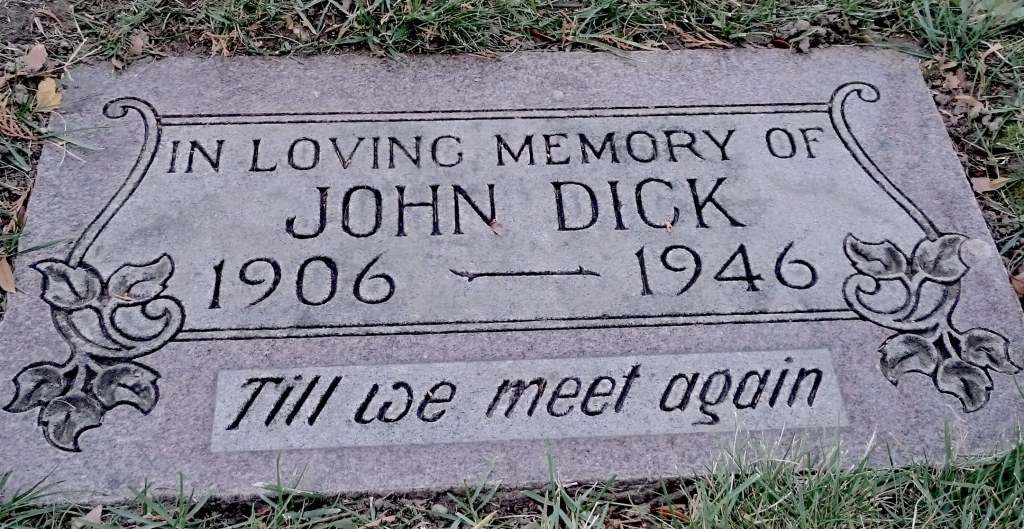
A. John Dick.
Q. John Dick, your brother-in-law?
A. Correct, sir.
Q. The husband of Evelyn Dick?
A. Correct, sir.
Q. Very well; you saw the torso there?
A. Correct, sir.
Q. And you say you recognized it at once?
A. Correct, sir.
Q. What enabled you to do that? How could you do that, Mr. Wall?
A. I saw John quite often shirtless, and I saw his body quite often at a time he was alive, and the first view of the body I was positive it was John’s body.
Q. Well, at that time had you been aware that he was missing? Did you know that, that he was missing?
A. Yes, I did found that out.
Q. Well, did you not know it before you ever went into that place?
A. Since the night before, as I called to Hamilton—-
Q. You had learned that from his wife from the telephone?
A. That is correct, sir.
Q. Did you know it before that?
A. No, sir.
Q. Then we have you finding out about John being missing from your telephone conversation with the wife so when you walked into this place where you saw the torso, you knew that John was missing?
A. That is right, sir.
Q. And you saw one, and you say that you identified it?
A. That is right, sir.
Q. I see; that is the order?
A. That is right.
Q. Very well, now, continue. I don’t want to interrupt you. Will you please tell us? You have told us that you had seen him stripped before?
A. Correct, sir.
Q. And what did you see there, please, in that place?
A. I saw the size of the body, I saw the hairless chest, I saw the stubs of his arms, and that gave me enough proof to be sure that that is John’s body.
Q. And did you say so?
A. Yes, I did.
Q. To whom?
A. To Dr. Deadman and to the inspectors who were with us there.
Q. And was your brother present at the same time?
A. Correct, sir.
Q. And did he inspect the body at the same time and in the same way as you did?
A. He just had one look on it, and he turned away and went out of the door, went to the door, didn’t look much on it.
Q. But I gather that you made a more careful inspection?
A. That is right, sir.
Q. And you are satisfied as to what you are swearing to?
A. Right, sir.
Q. And to its being true?
A. Yes, that is right sir.
Q. All right, Mr. Wall. Now then, following that, is there anything that you can tell us? What else happened following that?
A. Well, Dr. Deadman asked us—
HIS LORDSHIP: No, no.
MR. RIGNEY: Q. Don’t bother, please, about that Mr. Wall. You see, we are not entitled to give any conversations, but we are entitled to tell about acts what you did.
HIS LORDSHIP: What you saw.
THE WITNESS: Yes, my lord.
MR. RIGNEY: Q. Yes, what you saw. Now, please tell us if there was anything else that you observed after you were satisfied in your mind that that was John’s body; did you notice anything else that changed your opinion?
A. All I could say, sir, is just that much, it was to me — if I see a person many times and see him again, that is just in the first moment I recognize that person, without thinking much what is what.
Q. But after you examined him more closely you might find something that would change your first thought; did you do that in this case?
A. Yes, I did.
Q. What did you change?
A. His hairless chest proved one thing. His piece of leg at the right side, the right leg, the size of it, the way I saw it before, I thought it was exactly John’s body.
Q. You still thought and still think today that it was his body, I understand?
A. That is correct, sir.
Q. You did not find anything that caused you to change your opinion?
A. No, sir.
Q. You are of that opinion today?
A. Correct, sir.
Q. Now then, what next? After you examined the body what next did you do or what next did you see?
A. From there we went home, we went to Alex Kammerer’s place. We stayed there for an hour, about and then Jake and I went home.
Q. The same day?
A. That is right, sir.
Q. Now, were you at the funeral?
A. Correct, sir.
Q. Was your family there?
A. Yes, sir.
Q. Your brother Jake?
A. Yes, sir.
Q. Was his wife there?
A. Yes, sir.
Q. Jake’s wife?
A. Yes, sir.
Q. Was John’s wife there?
A. Yes, sir.
Q Sure?
A. Yes, I am.
Q. What John are you talking about?
A. John, myself, I thought you meant. I am John.
Q. You are John.
A. I thought you meant John and Jake.
Q. John and Jake. I was speaking of John Dick.
A. No, sir.
Q. What does your answer “No” mean? What are you answering “No” to? Was John Dick’s wife at the funeral?
A. No, she was not.
Q. How long was it held after you identified the body in the manner you have described?
A. I would say roughly about ten days, eight to ten days.
Q. In Hamilton?
A. Correct, sir.
Q. What kind of health did your brother-in-law John Dick enjoy? Was he a healthy man?
A. He was, except his back was not too good. I remember was — was a while ago, he worked for Freeman’s (they mean Fearman’s), and he was once paralyzed, pretty near paralyzed, for two weeks, maybe a little better, couldn’t hardly be lift up himself, he hardly could handle his body. I knew that. And he had on the lowest end of his spine, he had a place, he told me once, he had to be careful if he slips in his truck to deliver the meat, that if he hit that part, he says that really hurts him.
Q. How did he walk?
A. I wouldn’t understand, sir, exactly what you mean by—
Q. Was there any impediment, or did he walk normally, the same as people who are bless with the use of their legs, or did he walk in any peculiar fashion?
A. I don’t think so. I guess he walked just like any person, at least like he was always walking since I saw him.
Q. Well, did you notice anything unusual or peculiar about the way in which he walked?
A. I never looked that much, never noticed.
Q. You never noticed it, you mean?
A. No, sir.
Q. If there was anything?
A. If there was anything, that is right, sir.
HIS LORDSHIP: Mr. Rigney, I think we might take our morning recess. I thought we would have taken it before now. Maybe you can finish a little later, if you will.
MR. RIGNEY: Thank you.
HIS LORDSHIP: Take the accused out.
(Interval from 11:45 a.m. until 12:08 p.m.)
MR. RIGNEY: Q. You are still under oath; you understand that?
A. Yes.
Q. We were talking about the manner in which John Dick walked, and you say there was nothing peculiar as far as your observation went?
A. That is right, sir.
Q. And you told us about something that he complained of at the base of his spine or something of that kind?
A. Correct, sir.
Q. Was there anything else that you could tell us that was peculiar about him in a medical way, what sort of body?
A. Except those two things, what hurts him once in a while, at the—
Q. What are the two things that hurt him once in a while?
A. One was he had a sore spot right on the end of his backbone, and the other was right in his back, if he was lifting sometime, heavy stuff, he was getting a sore spot right in his back.
Q. He was subject to a sore back?
A. Correct, sir.
Q. And it was affected by his lifting?
A. Correct, sir.
Q. Did you see him doing any lifting yourself that affected his back?
A I didn’t see it — I might some, but the way I know, he told me once—
Q. Well, never mind, thank you. All I wanted to know was if you ever saw how he walked after he was lifting?
A. I don’t remember, sir.
Q. You don’t remember; that is all right. Now, what about his eyesight? Did he wear glasses?
A. No, sir.
Q. What about his teeth?
A. He had a small bridge, about two or three teeth — I wouldn’t say exactly — about two or three teeth were false.
Q. Do you know in what part of his mouth that bridge was or those teeth were?
A. I couldn’t say exactly sir.
Q. Did he have any more than that?
A. No, just a small bridge, as far as I know.
Q. When did you learn that?
A. I saw him a few times taking it out, but one time I remember right now he was in my place and he was eating something, and he jumped up and he took his teeth out and run up to the water and washed the teeth.
Q. When was that? I don’t mean the day or the week or the month.
A. It was about — in the summertime, about ’45 in the summertime.
Q. That would be a year ago this past summer?
A. Correct, sir.
Q. And was that the first time that you knew about the teeth?
A. I wouldn’t say exactly; I can’t remember exactly, but I thought I saw them once in his mother’s place laying on the table.
Q. When would that be?
A. About the same summer I guess, but I wouldn’t say it for sure, because I am not quite sure.
Q. You think it was in ’45?
A. That was in ’45.
Q. Do you know who his dentist was, what dentist he got the teeth put in by?
A. No, sir.
Q. Didn’t ever learn that?
A. No, sir.
Q. Thank you.
Your witness, Mr. Sullivan.
CROSS-EXAMINED BY MR. SULLIVAN:
Q. What is your nationality, Mr. Wall?
A. I am a Russian born Mennonite; by racial origin I am Dutch.
Q. By racial origin you are Dutch?
A. Correct.
Q. Born in East Prussia?
A. No, sir; in Russia.
Q. In Russia?
A. Correct, sir.
Q. What is the correct way of spelling your name?
A. W-a-l-l.
Q. W-a-l-l?
A. Correct, sir.
Q. It is through your wife that you are connected with the Dick family?
A. Yes, sir.
Q. And where do they come from?
A. From Russia too.
Q. From Russia; the same section as you?
A. By my father-in-law they are Mennonites; by her mother they are Rotarians, belong to the Rotarian Church.
Q. What is their racial origin?
A. As far as I know, they came from the German part of Poland or the border of Poland, German part; it was a little after our forefathers came to Russia.
Q. That would be Silesia?
A. I guess it is from Silesia; I am not quite sure, sir, but I guess it is from there they came.
Q. Do you know when John Dick came to Canada?
A. Yes, sir.
Q When?
A. 1924.
Q. Did you ever see a passport that he had?
A. Yes; it was on my passport.
Q. On your passport?
A. Yes, sir.
Q. You mean you arranged that he come in as an immigrant?
A. No; we had to organize as families, so I took on my passport my mother-in-law, grandmother, John and Helen, what is now Jake’s wife, myself and my wife.
Q. You brought them out as a family?
A. Yes, sir.
Q. He did not have a passport of his own?
A. No, sir.
Q. When did he first come to Hamilton to work?
A. I wouldn’t say exactly, but I guess it is about ’28, sir.
Q. About 1928?
A. ’28, yes, sir.
Q. And he worked for the Fearman Company, I think you said?
A. Not that time.
Q. Whom did he work for?
A. He worked for a while in the Frost & Steel, and then he worked for Lighthouse.
Q. International Harvester Company?
A. I can’t tell you, sir, if he worked there too, because I was not much acquainted with Hamilton.
Q. Did you see him quite often after he came to Hamilton?
A. Yes, I did.
Q. And you have told the Court that you have seen John Dick undressed?
A. Yes, I did.
Q. Was he fully undressed when you saw him?
A. I wouldn’t say fully.
Q. How far?
A. But he had his summer underwear once on, and it was just shorts.
Q. Summer shorts?
A. Summer shorts.
Q. How did you happen to see him dressed in that fashion?
A. As far as I remember, I had been at his mother’s place, and he had a rest and then he changed his Sunday clothes to the uniform of a street car conductor, and I was in that room as he changed his clothes.
Q. Was that the fullest extent to which you ever saw him unclothed?
A. No; we swim sometime together.
Q. You swim together.
A. Yes.
Q. Where?
A. At Ontario lake.
Q. And was he naked when you saw him swimming?
A. He had a bathing suit on.
Q. Had a bathing suit on?
A. That time.
Q. That would be a pair of bathing trunks, I presume?
A. That was — yes, shorts too.
Q. And it was from those observations that you say that he had very little hair on his chest; it is from seeing hime like that that you say that to this Court, is it?
A. Yes.
Q. Now, you went to the Morgue, as you have told us, to identify the torso?
A. Correct, sir.
Q. And on your first place at it you say you thought it was John Dick’s body?
A. Yes, sir.
Q. And I think, if I understood you correctly when you were giving your evidence, you said that when you see a person first you know it is that person?
A. After you saw him about twenty or thirty times maybe.
Q. As soon as you saw him again you know it is that person?
A. Correct, sir.
Q. And on that occasion, to know that that torso was John Dick’s, what portion of the torso did you fasten your attention on to make that instantaneous decision?
A. On the whole thing as such, sir.
Q. On the whole thing?
A. Yes, sir.
Q. As soon as you saw it you knew right away?
A. Yes, sir.
Q. That it was John Dick’s body?
A. Yes, sir.
Q. It was just the general appearance of the torso that made you decide immediately that it was John’s body?
A. Yes, sir.
Q. Now, I did not quite understand you about your evidence regarding the teeth. What did you say about false teeth? A plate?
A. No, it was a small bridge he took out that time and washed in my kitchen.
Q. That was at his mother’s place, you say?
A. It was in my place.
Q. At your place?
A. Yes, sir.
Q. Where did the bridge fit in his mouth?
A. I never saw that. I saw just grabbing it, and I saw he had that under the water there; that is all I saw it.
Q. Did you notice how many teeth were on the bridge?
A. I wouldn’t say exactly, sir, but it was not more than three.
Q. It was not more than three?
A. I don’t think so.
Q. And what portion of the mouth did it come from?
A. I wouldn’t say that either, because I saw just how he grabbed it, and I saw he had it in his hand, and he pulled it in again, put it back again.
Q. Most people with false teeth was them after meals; is that your observation?
A. I don’t know, sir. He was eating, I don’t know what it was; it was not at a meal.
Q. It was not at a meal?
A. It was not at a meal. We had something at the table, I don’t remember what it was, and he just jumped out and grabbed his teeth and ran to wash them.
Q. When you make the motion of grabbing his teeth, you rich up with the thumb underneath going into the mouth; is that what you mean?
A. He just reached to his mouth; I don’t know how he did it.
Q. With the fingers of the hand uppermost?
A. I wouldn’t say that, sir.
Q. You don’t remember?
A. I don’t remember that.
Q. But you saw him in a quick motion take teeth out and wash them?
A. That is right, sir.
Q. Now, do you know how many natural teeth he had?
A. No, sir.
Q. You have seen him smile often, I guess.
A. I did.
Q. Did he have natural teeth in the front?
A. As far as I could see.
Q. They were natural in front?
A. Yes, sir.
Q. Top and bottom?
A. I don’t know if they were all natural, if the bridge were on top, I don’t know that, but I mean he had his teeth in his mouth; that is what I meant.
Q. You don’t know whether they were natural or not?
A. No, sir.
Q. That is all, thank you.
HIS LORDSHIP: Next witness.
Source: RG 4-32 – Attorney General Central Registry Files, File 1946 Archives of Ontario.
 The Evelyn Dick Files